
PLAIN ENGLISH
Every term the calculators and guides use, in words that don't assume you already know. If a definition here still doesn't land, that's our problem to fix — tell us.
POWER & CURRENT
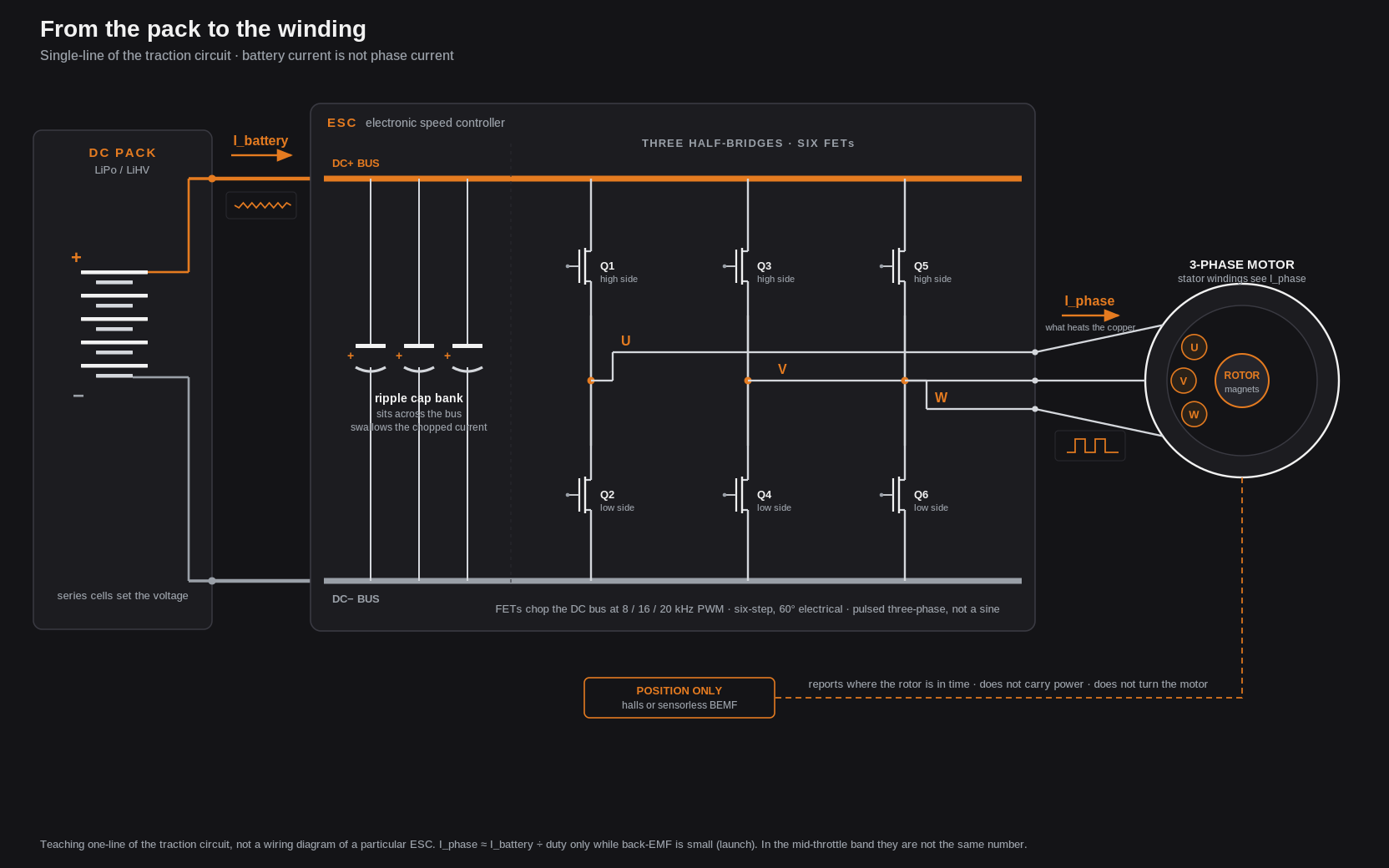
Battery current is on the pack side of the FETs. Phase current flows in the motor leads and heats the copper. The dashed feedback line reports rotor position, not power. Scroll sideways to read the one-line.
Duty cycle %
The share of time your ESC's transistors are actually switched on. The ESC can't give the motor a part of the battery voltage, so instead it switches full voltage on and off very fast — 16,000 times a second is typical — and the motor averages it out.
It is not your throttle position. At launch you can be holding full throttle at 30% duty, because the motor isn't turning yet and anything more would be an enormous current. As the car speeds up, duty climbs toward 100%.
Where you'll see it: Ripple Pack calculator. Quick check: duty ≈ battery amps ÷ phase amps. Ripple current is I·√(D(1−D)): smallest near 0% and 100% duty, worst at 50%.
Phase current A
The current actually flowing in the motor's windings. Whenever the ESC is chopping, this is higher than the current leaving your battery — sometimes several times higher.
At 30% duty, 180 amps out of the battery is 600 amps in the motor. The battery supplies the average; the capacitors on the ESC bus supply everything that changes faster than the battery leads can follow.
Where you'll see it: XC's X.BUS telemetry reports it directly. Castle logs battery current only, so you have to work it out. See the one-line: phase current is on the motor side of the FETs
Battery current A
What your ESC log usually shows: the current leaving the pack. It's the average of the chopped-up current the motor is really drawing.
Where you'll see it: Castle calls this "battery amps". Most logs show only this. See the one-line: battery current is on the pack side of the FETs
PWM frequency kHz
How many times a second your ESC chops the voltage on and off. 8, 16 and 24 kHz are common. Higher frequency means less ripple voltage for the same bank of capacitors, but slightly more heat in the ESC's transistors.
Where you'll see it: your ESC's programming app or card. See the one-line: the FETs chopping the DC bus
Six-step drive mode
The way most RC ESCs drive a motor: energising two of the three wires at a time and switching between six combinations as the rotor turns. Simple and robust, but it delivers torque in discrete kicks rather than smoothly.
Where you'll see it: Burst Physics, the timing chapter. The alternative, FOC, is smoother and far less common in RC.
Timing / advance degrees
Firing each step slightly early, so current is already building when it's needed. It buys rpm, and it costs heat and magnet stress. "Boost" and "Turbo" are brand names for ramping it in as revs climb.
Where you'll see it: Burst Physics, the timing chapter.
CAPACITORS
ESR milliohms, mΩ
Equivalent Series Resistance — the resistance built into a capacitor. It's the single most important number on a capacitor for our use, and it's the one distributors usually don't print.
Low ESR means the capacitor can dump current fast without heating up or dropping voltage. Two 470 µF capacitors beat one 1,000 µF of the same family, because putting them in parallel halves the ESR while only doubling the capacitance.
Where you'll see it: Ripple Pack calculator and Guide. ESR sets most of the ripple volts, so it sets how many caps you need. Measured with an ESR meter, which tests near 100 kHz.
Ripple current A rms
The back-and-forth current a capacitor carries as the ESC switches. It's what heats capacitors up, and a capacitor's "ripple rating" is how much it can take forever.
A 3 second drag pass is not forever. Running about 5 times the rating for one pass is fine (8 × Rubycon 63ZLH820 warm about 2.5 °C, EST) — the limit is heat per pass, not amps.
Where you'll see it: on every capacitor datasheet, and in the Ripple Pack calculator (heat per pass).
Capacitance microfarads, µF
How much charge a capacitor holds. It's the big number on the side, and it's the one most people shop by — which is why so many cap packs are the wrong ones. More microfarads is not automatically better.
Where you'll see it: everywhere. Pair it with ESR before you decide anything.
Bus / DC bus
The ESC's main power rails, where the battery comes in and the capacitors live. "Mount it at the bus" means right at the ESC, not at the battery end of the leads.
Where you'll see it: Ripple Pack Guide, page 6: the caps go right at the ESC. See the one-line: the DC bus and the caps that sit across it
Resonance Hz
Your battery leads have a little inductance and your capacitors have capacitance, and together they form a circuit with a natural ringing frequency — like a bell. If the motor's switching happens to hit that frequency, the ringing builds up and the voltage overshoots.
Short leads and caps right at the ESC keep it out of the way.
Where you'll see it: build notes in the Ripple Pack Guide.
ESL the voltage spike
Equivalent Series Inductance. Every capacitor and every bit of wire resists a sudden change in current, and that produces a sharp voltage spike at each switching edge. No amount of bulk capacitance fixes it — it needs small ceramic capacitors right at the transistors and the shortest possible loop.
Where you'll see it: right at the ESC. Keep cap legs and leads short.
MOTORS
kV rpm per volt
How fast the motor spins for each volt you give it, with nothing attached. A 1850 kV motor on a 33.6 V pack spins about 62,000 rpm unloaded. Lower kV is not a weaker motor — it's a different gear ratio built into the windings.
kV is also a flux measurement. If a motor's kV comes back higher than it was, you've permanently lost magnet.
Where you'll see it: the motor label, and every calculator on this site.
Kt torque constant, N·m per amp
How much twist you get per amp. It's locked to kV: Kt = 9.549 ÷ kV. You cannot have high kV and high torque per amp — they're the same number seen from two sides.
Where you'll see it: Burst Physics. It's why a low-kV motor pulls harder per amp.
Poles 2 / 4 / 6
How many magnets are on the rotor — not how many slots the stator has. Pole count sets how many electrical cycles happen per turn, so a 6-pole motor switches three times as fast as a 2-pole at the same rpm.
Where you'll see it: motor specs and Burst Physics. Unsure? Most RC motors are 4 or 6.
Demagnetization
Permanently weakening the rotor magnets. Too much current while the motor is hot pushes the magnet past the point it can recover from, and it never comes back.
It shows up as a motor that lost punch but revs higher — because less magnet means more rpm per volt. The loss is concentrated on one edge of each magnet pole.
Where you'll see it: Burst Physics, the demagnetization chapter.
Saturation
The point where the stator iron can't carry any more magnetic field. Past it, extra amps stop producing much extra torque and just make heat. It's why doubling the current doesn't double the push.
Where you'll see it: Burst Physics.
Sensored / sensorless
Sensored motors tell the ESC where the rotor is with little sensors inside. Sensorless ESCs work it out from the voltage the spinning motor generates. Sensored starts smoother from a dead stop; both can have timing applied.
Where you'll see it: Burst Physics, the timing chapter. See the one-line: the dashed line is position, not power
BATTERIES
Internal resistance IR, milliohms
The resistance inside the cells themselves. This — not the C rating — is what decides how far your voltage falls when you pull the trigger. Lower is better, and it's the number worth paying for.
Where you'll see it: good chargers measure it per cell. Battery Sizing Calculator asks for it.
C rating
A marketing number. It's meant to say how fast a pack can be discharged, but nobody polices how it's measured, so two packs with the same number can behave completely differently. Use internal resistance instead.
Where you'll see it: on every pack label, and nowhere in our math.
S and P series and parallel
S is how many cells are stacked to add voltage — 6S is six cells, about 25.2 V full. P is how many of those stacks are wired side by side to share the current. 6S2P is two 6S packs in parallel: same voltage, half the resistance.
Where you'll see it: every calculator.
Sag volts
How far pack voltage drops when you demand current. It's just Ohm's law: voltage lost = current × resistance, including your leads and connectors. Sag is why a car that calculated fast on paper is slow in the lights.
Where you'll see it: Drag Battery Sizing Guide and the Battery Sizing Calculator.
A word missing, or a definition that didn't help? Send it over and it gets added: evul@evulempire.com · (724) 338-8557